ai-automation
What It Costs to Build and Run a Small Business AI Workflow
The price of using an AI model is only one part of an AI workflow's cost. A business also needs a working connection to its software, someone to check uncertain results, and a way to keep the process reliable after launch.
For a founder or operations manager, the useful number is the cost of completing the whole task to an acceptable standard. That includes the cases staff still handle manually.
A sensible budget separates the initial build, technical running costs, and continuing staff effort. Then it compares those costs with a measured change in the work. A cheap service can still make an expensive workflow if people spend too much time correcting it.
Define the job before estimating the build
Describe the input, output, and person responsible for approving the result. Processing supplier documents could mean extracting a few fields into a review screen. It could also mean matching purchase orders and posting approved entries into an accounting application. Those are different projects.
The integration is one of the main cost variables. A supported API with suitable permissions can reduce the work needed to connect systems. Missing endpoints, inconsistent identifiers, or business rules that exist only in a staff member's head make the scope harder to price.
Review is another variable. Someone needs to decide when a result is acceptable, what happens when required information is missing, and how to resolve disagreements. Include their time in the estimate.
Maintenance matters too. Assign ownership for failed jobs, access changes, vendor updates, and checks that the workflow still produces useful results. Ask for those responsibilities in writing. A handover without an owner leaves work for your team even if the software keeps running.
Separate three kinds of cost
The upfront budget should cover understanding the workflow, building the necessary connection, checking representative examples, and handing it over. Staff time spent supplying examples and testing is part of the project effort. It should be included or identified separately, rather than silently treated as free.
Technical running costs can include AI usage, document processing, hosting, storage, monitoring, and a maintenance allowance. A maintenance allowance has limits. Confirm which repairs and changes it covers and how additional work is approved.
Staff review is recurring effort. It includes checking flagged cases, correcting outputs, and investigating failures. This may be existing payroll time rather than a new invoice, but it still belongs in an economic comparison.
Metering varies between services. Document extraction can be charged by page, as the Amazon Textract pricing documentation shows. Some cloud functions are metered by requests and execution resources, as described in the AWS Lambda pricing documentation. A document count alone is not a complete usage estimate.
A fictional planning example
Consider a fictional business that handles 600 supplier documents per month. Staff currently spend an average of three minutes on each document, giving 30 hours of monthly handling work.
The business uses a loaded staff cost of $35 per hour. Loaded cost includes the employment costs it chooses to allocate beyond wages. At that rate, the current handling effort has a value of $1,050 per month.
Suppose a hypothetical pilot measures a 40% reduction in handling time before adding a separate review step. That releases 12 hours of handling capacity, valued at $420. Staff still spend 18 hours on the remaining handling work.
The pilot also requires two hours of additional review per month. At $35 per hour, that review has a value of $70. Total staff effort after the pilot is therefore 20 hours, made up of 18 hours of handling and two hours of review.
The net time released is 10 hours per month. The 40% figure describes the gross handling reduction, not the final reduction in total staff effort.
Every amount and result in this example is invented for planning. It is not a DigitalCoding quote, a market benchmark, a client outcome, or a guaranteed result.
Put the assumptions in one table
| Item | Fictional planning assumption |
|---|---|
| Upfront project cost | $4,800 |
| Monthly technical running cost | $150 |
| Additional monthly staff review | 2 hours at $35 per hour, valued at $70 |
| Total monthly recurring economic cost | $220 |
| Gross monthly handling capacity released | 12 hours, valued at $420 |
| Net monthly capacity value after recurring costs | $200 |
For this example, the $4,800 is assumed to include setup, integration, testing, handover, and the allocated internal project time. The $150 monthly technical allowance includes usage, hosting, monitoring, and an agreed maintenance allowance. Actual inclusions would need to be specified in a proposal.
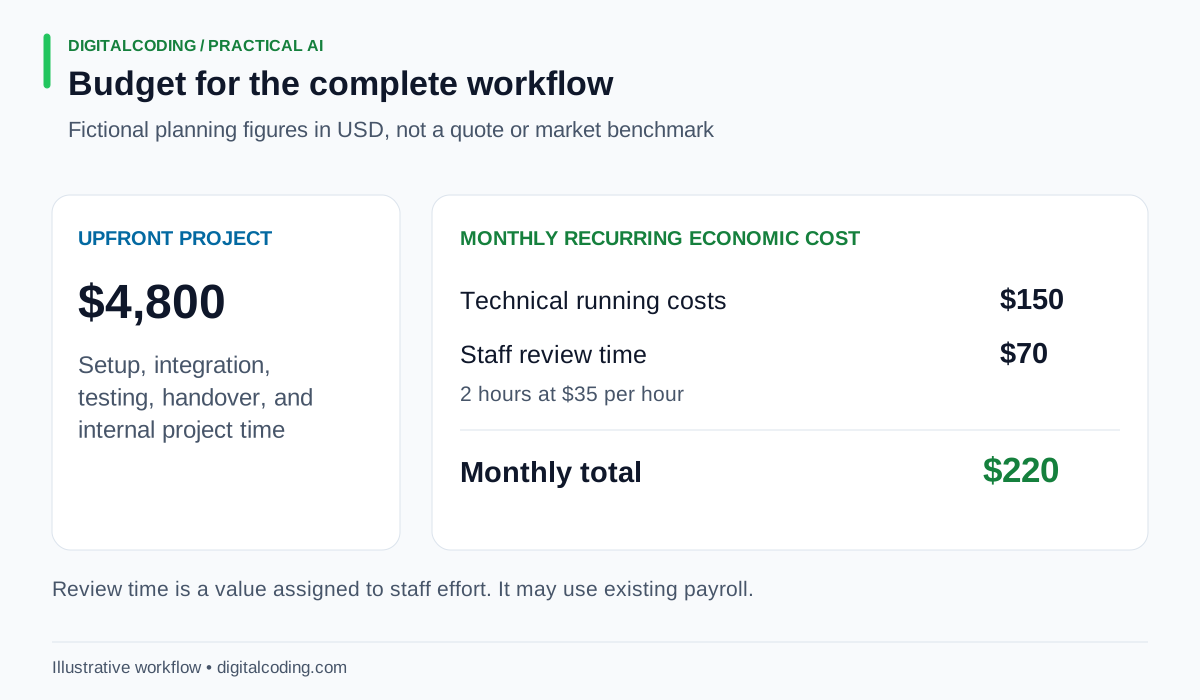
Fictional planning figures. The monthly total combines technical spending with the value of staff review time.
Calculate the benefit without counting review twice
There are two consistent ways to calculate the same monthly result.
Start with the gross handling capacity value of $420 and subtract the $220 recurring cost. The result is $200. The recurring cost already includes the $70 review allowance, so do not subtract it again.
Alternatively, start with the net 10 hours released after review. At $35 per hour, that capacity is worth $350. Subtract only the $150 technical running cost, and the result is again $200.
Dividing the $4,800 upfront cost by $200 gives a simple payback period of 24 months. That calculation assumes the same volume, measured performance, and recurring costs throughout. It excludes tax and discounting, which would affect a fuller financial assessment.
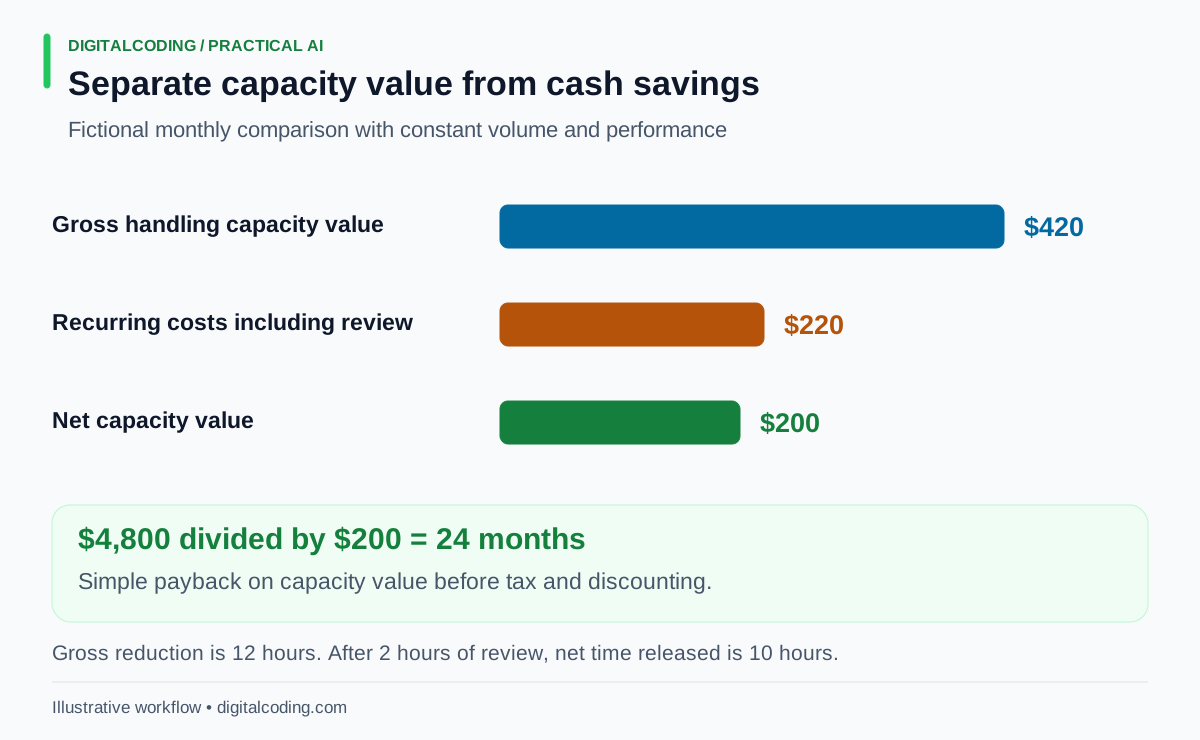
The payback uses the value assigned to released staff capacity. It does not promise a reduction in payroll or cash spending.
Released time has value only if the business can use it. Staff may address a backlog or spend longer on customers while payroll stays unchanged. If the work arrives in scattered small batches, the practical benefit may be lower than the hourly calculation suggests.
Decide whether the result is worthwhile
A 24 month illustrative payback may not be attractive. The business carries the upfront cost, while software changes or lower volumes could reduce the benefit. If an existing application feature covers enough of the job, use that as the comparison before commissioning custom work.
Measure a pilot with ordinary documents and awkward ones. Record handling time, review time, errors, rework, and cases returned to the manual process. Count failed attempts and repeated processing in usage estimates. Keep quality requirements steady when comparing the old and new processes.
Set a budget and agree when someone will check actual spending and staff effort. Expansion should depend on those results, not on the fact that the first demonstration worked.
How DigitalCoding Can Help
DigitalCoding can help turn a loosely described task into a costed workflow with explicit assumptions. Our founder brings more than 25 years of software development experience, including cloud systems and current AI work. That background is useful when the main expense lies in integration, permissions, or maintenance.
Our consulting service can assess an existing feature against a limited custom build. Our AI automation service can define a pilot that measures review effort as well as technical usage.
For an actual estimate, we need representative sample data, the software involved, available permissions, expected volume, and the output staff need. Start a project brief with those details and the current manual process. We can then identify the work that needs pricing and whether a smaller approach deserves testing first.