ai-automation
Connect an AI Assistant to Your Existing Business Software
Your team already has somewhere to look up orders, check customer records, and track work. An AI assistant becomes useful when it can work with those systems without creating a second, conflicting set of records.
That does not mean replacing your business software or giving a chatbot an administrator account. A sensible first connection might let an assistant retrieve an approved order summary and draft a customer update. A member of staff checks the facts and decides whether to send it.
The important design work is deciding which information the assistant needs, which actions it may request, and where your existing business rules are enforced.
Start with one job your software already supports
Choose a task with a clear beginning and end. Looking up an order and preparing a status message is easier to define than managing customer service.
Write down the steps a member of staff follows today. They identify the customer, find the order, check fulfillment, read any relevant notes, and prepare a reply. Then identify which system owns each fact.
The order application should remain the system of record. The assistant can explain its information, but its conversation should not become the authoritative order history.
Before building anything, check whether the software already includes an adequate assistant or approved connector. An existing feature may cover the task with less setup and maintenance. Confirm its permissions and review behavior rather than assuming that being built in makes it suitable.
For a custom connection, inspect the application's supported API. An API is an interface through which software requests information or actions from another application. If it already supports the necessary lookup, there may be no reason to change how the business stores orders.
Keep the application in charge of its rules
A common arrangement puts a small integration between the assistant and your existing REST API. REST is a common approach to organizing web APIs. The integration translates a narrow request, such as looking up one order, into the application's expected API call.
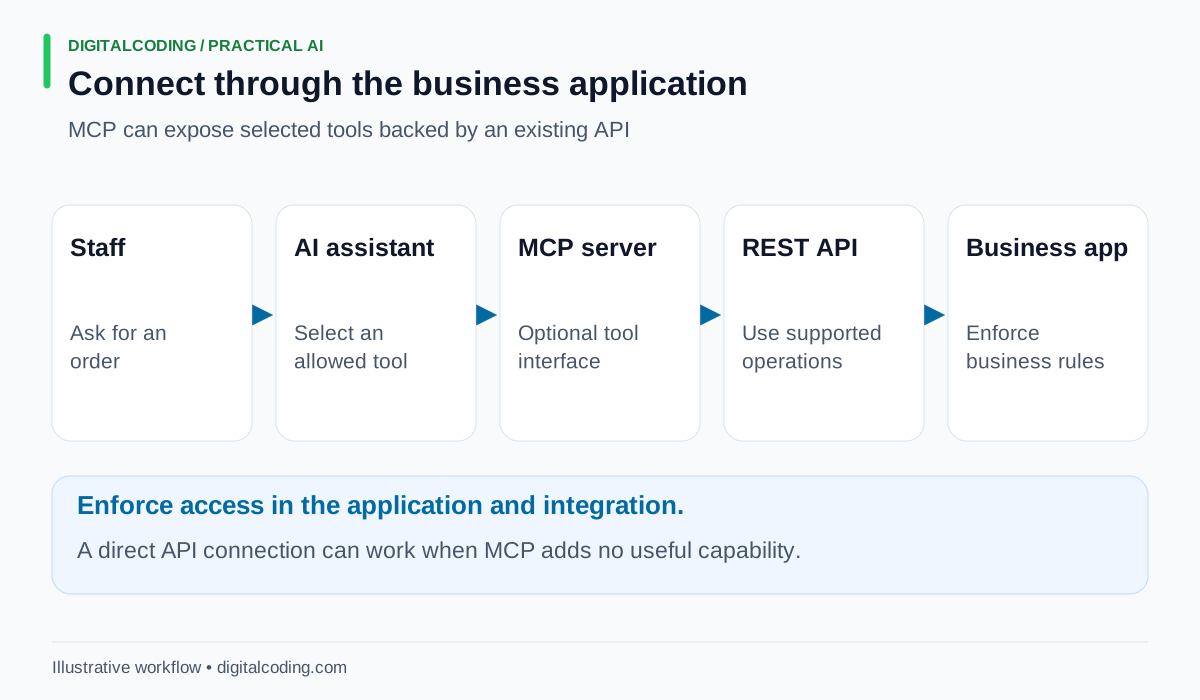
The assistant requests approved operations. The business application remains responsible for accepting or rejecting them.
Verify that the API actually enforces the required rules. A check that exists only on a staff screen may be missing from its API. The server must still reject access to another customer's order, an invalid status change, or a request from someone without permission.
Do not give the assistant unrestricted database write access. That can bypass application checks and leave records inconsistent with the rest of the system. If the API is incomplete, a small, properly validated application endpoint may be the necessary first step.
Where MCP can fit
Model Context Protocol, usually called MCP, is a standard for connecting AI applications to tools and information. It can provide a shared interface between an assistant and an integration. It does not replace your REST API, and using it does not guarantee security.
There are three roles to understand. The host is the AI application a person uses. An MCP client is the component inside that host that communicates with a particular MCP server. The server exposes capabilities, such as an order lookup tool. The official MCP architecture guide explains these roles.
A tool definition describes an operation and its expected inputs. For example, a lookup tool might require an order reference. Its implementation checks the request and calls the existing order API. The MCP tool specification defines tool descriptions and input schemas.
MCP is optional. A single assistant with one existing integration may work well with a direct API connection. Use the additional layer when supported hosts and reusable tools make it worthwhile. It still needs an owner, testing, and maintenance.
A fictional order assistant in practice
Consider a fictional small wholesaler that receives customer requests for delivery updates. Its staff use an order application with a supported API.
The first pilot provides two narrow capabilities. The assistant can look up an order the signed-in employee is allowed to view, and it can draft an update from the returned details. It cannot issue refunds, change delivery addresses, mark orders shipped, or send messages itself.
A staff member enters an order reference. The integration verifies their access and retrieves the approved fields, including the order status, recorded dispatch date, and tracking link if available. It excludes payment details and unrelated internal notes.
The assistant prepares a draft and displays the source details beside it. If the order has not shipped, it should say that the application records it as awaiting dispatch. It should not invent a delivery date to make the reply more complete.
The employee checks the draft and sends the message through the existing customer service process. If the record is ambiguous or the API is unavailable, the assistant hands the task back with a clear explanation.
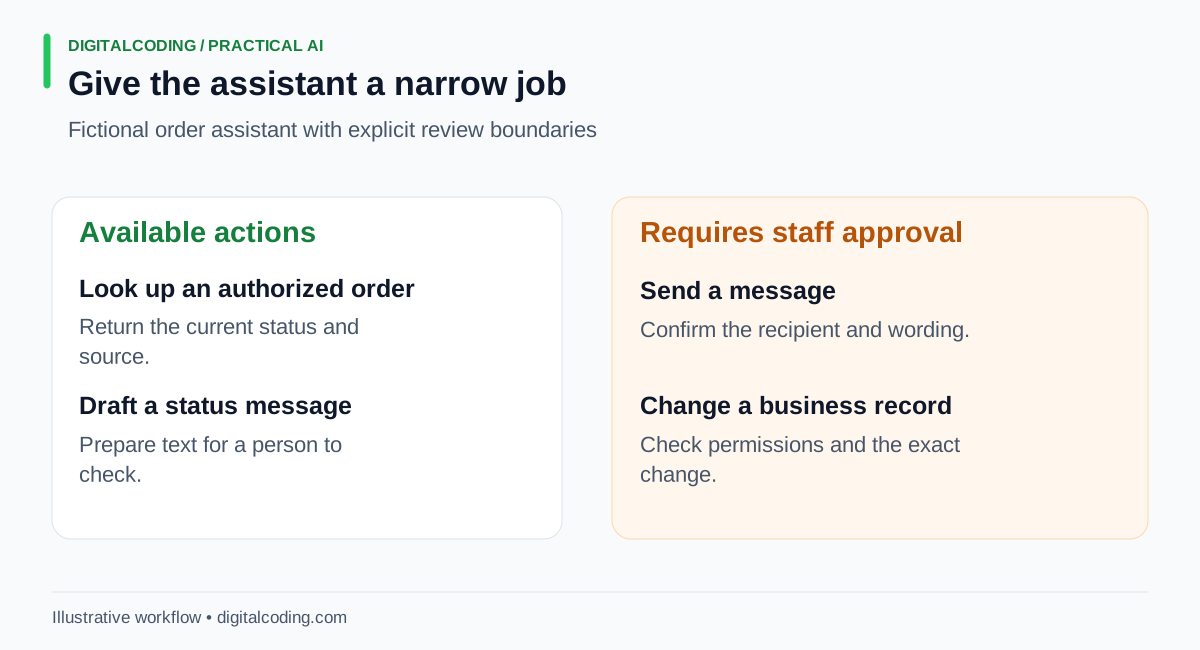
Begin with lookup and drafting. Any later sending or record changes need their own permissions and approval steps.
This example is a proposed design, not a report of a client project or measured results. Its value would need to be established with the wholesaler's actual workload.
Permissions need enforcement outside the conversation
Telling an assistant to avoid restricted records is not an access control. The integration and application must verify the employee's identity, the requested operation, and access to the particular record on every call.
Use the narrowest suitable permissions. Keep credentials out of prompts and customer-facing responses. Decide which fields can leave the source application and which services will receive them. MCP's security guidance describes risks that still require deliberate controls, including token handling and consent.
Review controls belong in the application flow. If sending becomes part of a later version, show the recipient, message, and relevant order details before approval. Tie that approval to the exact action being executed. A general instruction to proceed should not authorize unrelated future changes.
Keep a useful record of the employee, order reference, requested operation, approval, and outcome. Avoid copying unnecessary personal data into logs. The MCP tool specification's security requirements include input validation and access controls, with audit logging recommended for clients.
Plan for failures before adding writes
A slow response does not necessarily mean an action failed. If a future version sends a message and loses the response, repeating the request could send it twice.
Design retries around the destination system's documented behavior. Some APIs support an idempotency key, which identifies the same intended operation across retries. Stripe's idempotent request documentation provides a concrete example. Your order or messaging system may work differently, so verify its guarantees rather than assuming the feature exists.
Where those guarantees are absent, record pending operations and reconcile uncertain outcomes before retrying. Staff need a visible way to resolve a stuck task. Keep the normal application available as the fallback.
How DigitalCoding Can Help
DigitalCoding can inspect one workflow, the application's API, and its permission model before recommending a connection. Our founder brings more than 25 years of software development experience, including cloud systems and current AI work. That experience helps distinguish a small integration from a project that first needs changes to the underlying application.
Our AI automation work can cover a limited pilot and its review process. Where an API needs improvement, our software development service can address that specific gap.
Contact DigitalCoding with the software you use and one task staff repeat. Include the action you want to allow and the decision a person should retain. That is enough to begin assessing a practical first connection.