ai-automation
Reconcile Bills of Lading and Freight Invoices With AI
A freight invoice can look reasonable while referring to the wrong shipment, a revised quantity, or an extra service that nobody has confirmed. Checking it often means opening several documents and finding the right email thread before the comparison can begin.
AI can help collect the shipment facts from those documents. The reconciliation still needs rules, source evidence, and a person responsible for unresolved differences. A useful workflow brings the documents together and explains each mismatch before an approved update reaches the transport or accounting system.
For a small logistics team, start with one carrier or shipment type. Different transport modes and commercial arrangements can require different evidence.
Give each document a specific job
A bill of lading, often shortened to BOL, records shipment details and has a transport role. FedEx Freight's BOL guidance describes contents, origin, destination, references, and freight classification among its information. It is useful shipment evidence, but the BOL alone does not establish that every invoiced charge is correct.
A proof of delivery, or POD, records delivery information. It may include the recipient's acknowledgement, date, quantities, or exceptions, depending on the record. Check what the actual document says. A delivery status alone may not provide a pallet count or evidence that an additional service occurred.
A rate confirmation or applicable contract provides the agreed basis for charges. The carrier freight invoice requests payment for transport services. A commercial invoice bills for the goods themselves. The International Trade Administration's document guide distinguishes the commercial invoice from transport documents.
Classify these records before matching them. A commercial invoice total is not a substitute for the agreed freight rate.
Extract facts with a trail back to the page
AI can read carrier names, shipment references, pickup and delivery locations, dates, quantities, units, weights, and charge descriptions from varied layouts. It can propose that a scanned reference belongs to an existing shipment. Staff need to see the evidence behind that proposal.
Retain the original files and link each extracted field to its source page or document region where the chosen tool supports it. Keep the original wording beside any normalized value. Twelve pallets and twelve cartons should remain different quantities. Convert pounds to kilograms only with an explicit rule, while preserving the original value and unit.
Extraction confidence can help route uncertain fields. It does not certify the shipment or charge. Amazon Textract's best practices recommend thresholds that reflect the sensitivity of the work and additional scrutiny for uncertain results. Missing values should remain missing rather than being filled from a plausible guess.
Our article on document processing covers this separation between reading information and acting on it.
A fictional mismatch on shipment SHP-2048
This worked example is fictional. Shipment SHP-2048 has a BOL showing 12 pallets. Its delivery record shows 12 pallets received. The carrier freight invoice bills 14 pallets and includes a $75 additional charge.
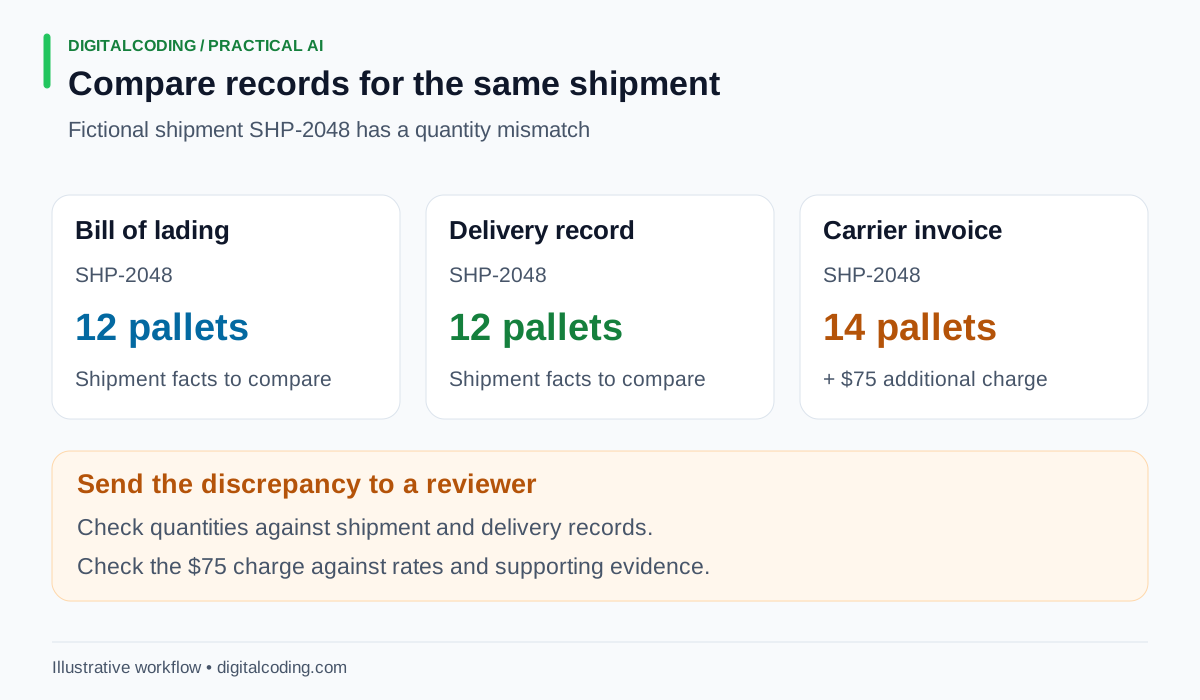
Shipment quantities disagree. The additional charge needs rate and service evidence before review can be completed.
The workflow links the documents to SHP-2048 and presents two exceptions. The first is the difference between the billed pallet count and the BOL and delivery record. The second is the additional charge without enough supporting evidence.
It does not automatically reduce the invoice to 12 pallets or remove $75. The billed basis could be wrong, or another relevant record could be missing. The logistics reviewer checks the shipment history and asks the carrier for clarification where needed.
For the additional charge, the reviewer needs the applicable rate terms and evidence of the service or event being billed. A BOL showing 12 pallets cannot by itself validate the price. Even agreement between the BOL and delivery record leaves the charge question open.
If the carrier issues a corrected invoice, retain both versions, mark which one replaces the other, and link the resolution. If the carrier supplies evidence supporting the charge, record the reviewer's decision and that evidence. Only the approved result proceeds to the system update.
Link shipments before comparing amounts
An exact internal shipment reference is a strong starting point. Check it against the carrier and relevant shipment details. Carrier invoice numbers, tracking references, BOL numbers, and purchase order numbers identify different things. Do not treat them as interchangeable.
When a reference is missing or ambiguous, use dates, locations, carrier, and available shipment details to propose candidates. If two shipments fit, send them to review. A convincing match is still a proposal until the ambiguity is resolved.
Account for partial shipments and consolidated invoices. One order can move in several loads, while one carrier invoice can contain several shipments. Match at the appropriate shipment or invoice-line level. Track quantities already reconciled so another document cannot consume the same delivery evidence twice.
Amendments need version history. A revised BOL, corrected delivery record, credit, or rebill can change an earlier conclusion. Reopen affected checks and approvals rather than quietly overwriting the source values.
Separate shipment checks from price checks
Use fixed rules to compare shipment facts. Check identifiers, quantities, units, locations, and dates. Then check charges against the applicable rate confirmation, contract, or other agreed pricing evidence. Include the effective dates and relevant service conditions.
Keep any tolerance specific and approved. A permitted rounding difference in a calculated charge should not excuse a pallet discrepancy, missing delivery evidence, or an unsupported service fee. Document when a tolerance applies and who may change it.
Some differences need carrier evidence. FedEx Freight's dispute process distinguishes rate issues, reweigh reviews, inspection reviews, and documentation requests. That is a useful reminder that different exceptions need different supporting records. An AI explanation alone cannot settle them.
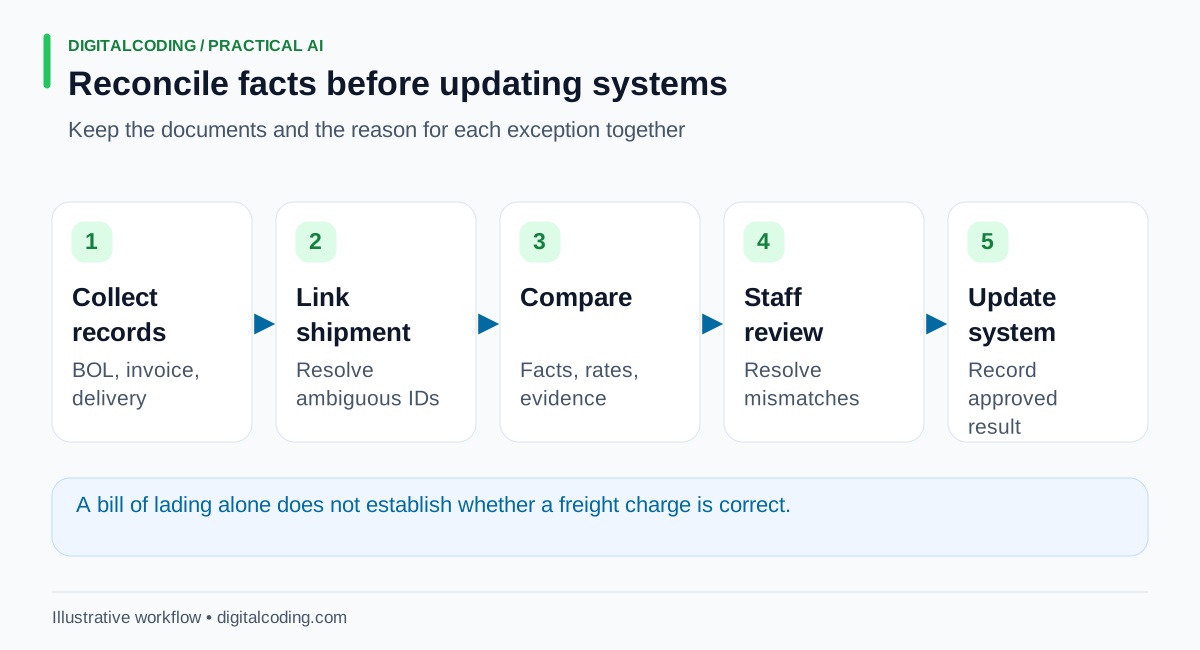
The review combines shipment facts with pricing evidence. Each unresolved difference has a named owner.
Keep review and integration practical
Give staff a queue with the shipment, disputed fields, source documents, reason for the exception, and next action. Route missing delivery evidence to operations, rate questions to the person managing carrier agreements, and disputed billing to the appropriate finance or logistics owner.
Keep correspondence and resolution dates attached to the case. Track unresolved work so a missing document does not disappear in an inbox. The reviewer should be able to approve supported values, request more evidence, or reject the proposed match.
Connect the result to existing tools. A team may begin with its shared document store, a controlled review list, and an import into its transport management or accounting system. Use supported integrations where available and limit access to the records the workflow needs.
Record the destination ID after an approved update. If the connection fails, check the destination before retrying. Repeated emails and restarted jobs must not create duplicate freight bills or repeat an adjustment. Retain who approved the change, the values sent, and the confirmed result.
Prove the process on a limited sample
Test ordinary shipments alongside partial deliveries, reused references, amendments, unreadable scans, and extra charges. Have staff compare the proposed results with the documents they would normally use. Track wrong matches, field corrections, missing evidence, review time, and confirmed system updates.
Keep customs and legal decisions with the qualified people responsible for them. Document reconciliation does not guarantee customs clearance or resolve the legal effect of a bill of lading.
How DigitalCoding Can Help
DigitalCoding can help define the document relationships, matching rules, exception queue, and approved handoff for your freight process. Our founder has more than 25 years in software development, including cloud systems and current AI automation work.
Through our AI automation services, we can scope a pilot around one carrier, route, or invoice format using your existing tools. Contact DigitalCoding with the documents your team compares and the differences that usually require a phone call or email. Those details provide a practical starting point for deciding what the workflow should prepare and what staff should continue to review.